Managing active bed bug infestations requires precision protocols that eliminate hidden populations without hazardous, excessive chemical drenching. According to guidelines set by the U.S. Environmental Protection…
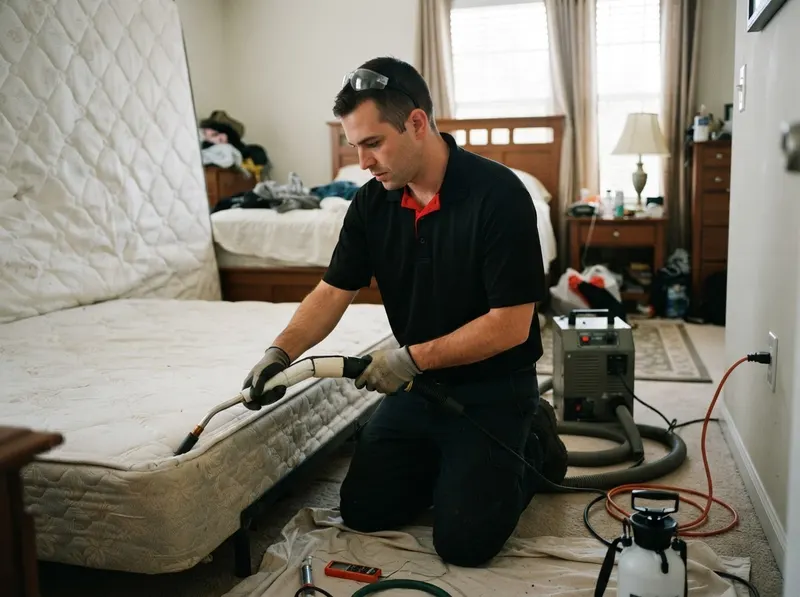
Managing active bed bug infestations requires precision protocols that eliminate hidden populations without hazardous, excessive chemical drenching. According to guidelines set by the U.S. Environmental Protection Agency, an Integrated Pest Management protocol blending thermal convection with targeted residual products achieves the highest eradication rates for modern synthetic-pyrethroid-resistant bed bug strains. In older historic residences in Shandon, Earlewood, and Elmwood Park, bed bugs frequently retreat into deep plaster wall voids, tongue-and-groove pine subflooring, and architectural baseboards where conventional aerosol sprays fail to reach lethal concentrations. By deploying forced-air thermal heaters monitored through calibrated sensors, room temperatures are sustained between 122°F and 135°F, exceeding the lethal thermal threshold documented by the Journal of Medical Entomology. The heat permeates deep inside box springs, dressers, and flooring assemblies, denaturing insect cellular proteins within minutes without damaging furniture or leaving lingering chemical odors.
While thermal remediation delivers an immediate knock-down of live adults and eggs, structure cooling leaves treated rooms vulnerable to re-infestation if individual insects survive in exterior wall cavities or insulated crawlspaces. To prevent perimeter escape and persistent re-emergence, technicians apply targeted non-repellent chemical barriers containing insect growth regulators and desiccants such as Clemson University Regulatory Services registered formulations. Standards from the National Pest Management Association confirm that pairing thermal remediation with localized perimeter chemistry prevents surviving specimens from establishing new harborages. Homes in neighborhoods like Forest Acres, Heathwood, and Lake Katherine with expansive multi-room layouts benefit from this dual-layered protocol, which establishes perimeter residual protection lasting 60 to 90 days.
Selecting remediation options involves balancing structural preparation requirements against treatment duration. A thermal-primary protocol requires residents to remove wax candles, pressurized aerosol containers, delicate oil paintings, and temperature-sensitive prescription medications before treatment, as outlined in structural preparation standards from the South Carolina Department of Environmental Services. In contrast, chemical-only treatments involve lower initial labor prep but require three to four separate visits spaced 14 days apart to catch nymphs hatching after initial applications, because conventional liquid sprays cannot penetrate the protective chorion layer of bed bug eggs as verified by University of Kentucky Entomology research. The hybrid thermal-and-chemical approach resolves the infestation in a single primary treatment day, backed by strategically placed interception traps and low-toxicity spot applications that safeguard children and domestic pets.
Urban residential properties along The Vista and Cottontown, as well as student housing surrounding the University of South Carolina Horseshoe, encounter rapid bed bug dissemination through shared walls and multi-tenant common spaces. The Centers for Disease Control and Prevention notes that while bed bugs do not transmit bloodborne pathogens, the persistent sleep deprivation and allergic skin reactions caused by saliva proteins warrant immediate eradication. Technicians assess room layouts, seal service penetrations, apply treatment in accordance with the Occupational Safety and Health Administration worker safety standards, and provide follow-up inspections adhering to safety recommendations from the U.S. Army Public Health Center to verify complete clearance.
Every job gets a firm, written price after a free on-site visit.
Tell us about your bed bug thermal and chemical remediation job in columbia and we'll send a clear, written quote, usually the same day.
 StoneHarbor Pest Relief